

The Saga of Princess Jieyou (Part 8)
Continued from "Yu's Reincarnation Stories: The Saga of Princess Jieyou (Part 7)"
Humiliation of Princess Jieyou
On the very day Ni Mi ascended the throne, he staged a lavish wedding with Princess Jieyou. Arrogantly, he believed that once the princess belonged to him, the entire Western Regions would fall under his control.
Just as Jun Xu Mi and Weng Gui Mi had foreseen, Ni Mi—violent, hot-tempered, and bloodthirsty by nature—immediately "followed" Princess Jieyou's earlier methods of rooting out Xiongnu spies, but twisted them into an excuse for a brutal purge throughout the Kingdom of Wusun.
He imposed harsh new laws under which anyone known to support the Han, or merely suspected of acting as a Han spy, could be executed without mercy. Before long, the people came to call him the Mad King.
The ministers, nobles, and influential clans who had once upheld the agreement and supported his accession deeply regretted their decision. Yet, fearing for both their positions and their lives, they dared not speak a word, lest they invite disaster upon themselves.
The Xiongnu ruler urged Ni Mi to produce an heir with Princess Jieyou as quickly as possible in order to secure the kingdom they had regained. But Princess Jieyou had no wish to bear him a single child.
She had long resolved to remain faithful to Weng Gui Mi for the rest of her life. Ni Mi, however, sought only to break her spirit through humiliation and force her into submission.
To fulfill her greater mission of overthrowing Ni Mi, Princess Jieyou—despite her exceptional martial skills—endured his violence and abuse in silence, allowing him to lower his guard.
With each humiliation she suffered, the anguish in her heart grew ever deeper. Witnessing her suffering, Liu Ye and Lady Feng were heartbroken. They knew they had to find a way to help her.
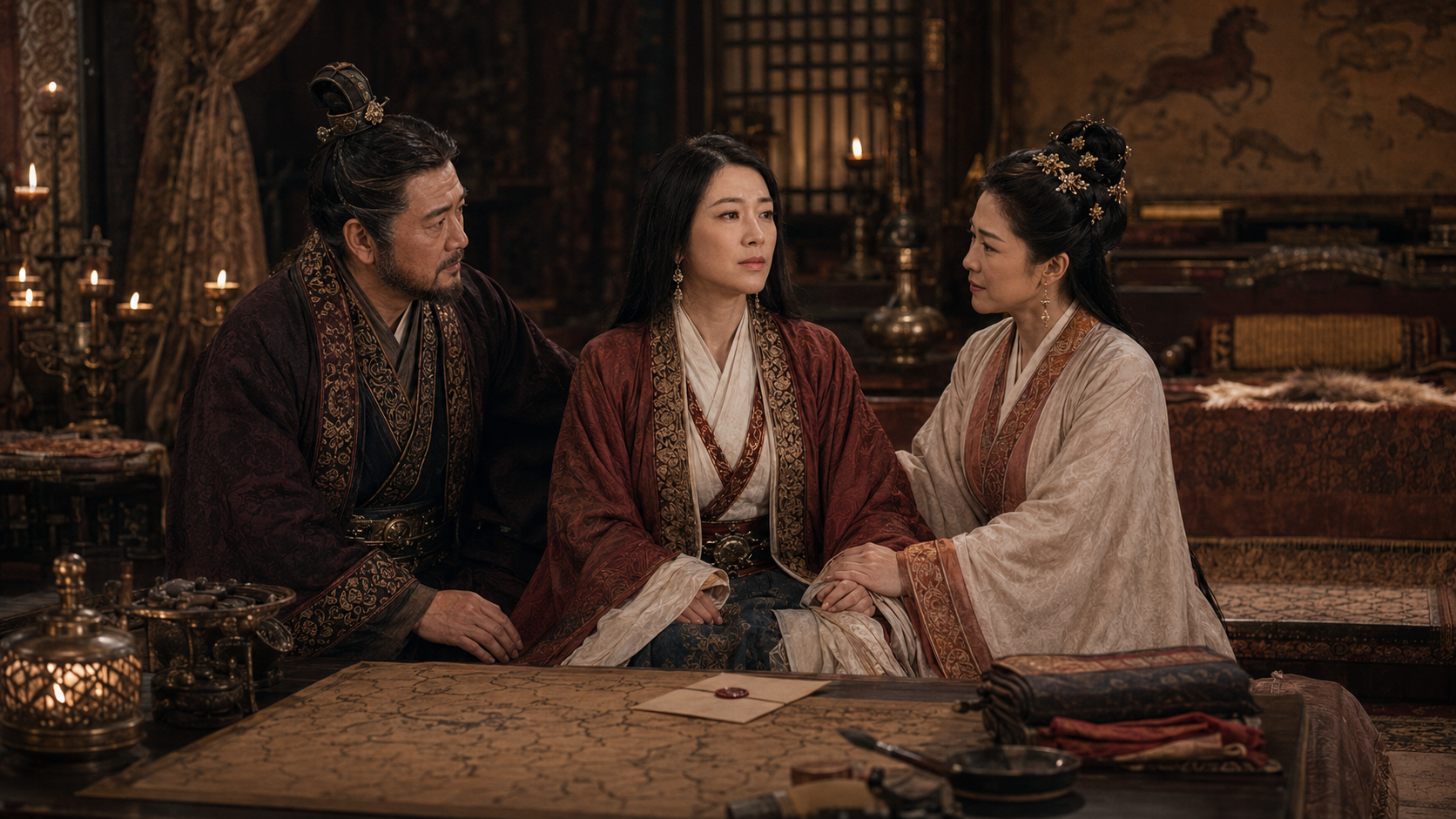
(AI Generated Visualization)
The Feigned Pregnancy
After a secret meeting, Princess Jieyou, Liu Ye, and Lady Feng devised a daring deception. They knew that, given Ni Mi's violent nature, he would continue to force himself upon the princess until she bore him a child.
Such a fate would condemn her to endless humiliation and suffering.
To carry out their plan, they found a Han woman in the early stages of pregnancy who had married a Wusun man. They concealed padded cloth beneath Princess Jieyou's robes to imitate the appearance of pregnancy and secretly bribed the royal physician to cooperate with the deception.
Ni Mi, however, spent his days indulging himself among his other wives and concubines, showing little interest in Princess Jieyou's daily life. To him, marrying the princess had merely been a means of securing the wealth and influence of the Western Regions. As a result, he never discovered that her pregnancy was a fabrication.
Before long, word of Princess Jieyou's pregnancy reached the Xiongnu ruler.
As the queen whom the people of Wusun admired and revered, Princess Jieyou's pregnancy with the child of the Mad King seemed to signal that she had accepted Ni Mi as her husband. The news filled the people of Wusun with despair.
To them, it felt as though the Mother of the Kingdom had abandoned her own people.
What they did not know was that, to protect the Kingdom of Wusun, the princess was carrying out a perilous plan to overthrow Ni Mi.
The Assassination of Ni Mi
After ten months of her "pregnancy," Princess Jieyou, with the help of Liu Ye and Lady Feng, presented a baby boy as her newborn son.
Overjoyed, Ni Mi held a grand celebration. On the very day of the feast, he named the infant Chi—a transliteration from the Wusun language meaning "one of pure Wusun royal blood"—and immediately invested him with the title of Mi, making him the Crown Prince.
When Emperor Xuan of Han learned of the birth through reports from the Western Regions, he immediately ordered Wei Heyi, the Senior Envoy stationed there, together with his deputy Ren Chang, to formally congratulate the Wusun court. To demonstrate the Han court's regard for this event, the two envoys were escorted by a large military contingent.
During the banquet, Princess Jieyou quietly placed the infant Chi Mi into Lady Feng's arms and urged her to carry him away without delay. She then exchanged a subtle glance with the Han envoy stationed in the Western Regions. Each raised a cup and took a sip of wine—the agreed signal that the plan was about to begin.

(AI Generated Visualization)
Suddenly, several assassins drew their swords and charged toward Ni Mi, intent on taking his life.
Outside the banquet hall, troops from the Han Empire were already lying in wait. Should Ni Mi escape the hall, he would immediately be confronted by the Han forces.
From the assassins' swordsmanship, Ni Mi realized they had come from the Central Plains. His guards quickly rushed to protect him. After a fierce struggle, Ni Mi was wounded but managed to break free.
When he fled the banquet under heavy guard, he found the grounds outside already surrounded by Han troops.
After a desperate fight, Ni Mi narrowly escaped with serious injuries. His own forces, composed largely of Xiongnu soldiers, clashed with the Han troops, leaving casualties on both sides.
Ni Mi's eldest son, Xi Shen Shou, quickly rallied his forces and surrounded Princess Jieyou, the Han envoys Wei Heyi and Ren Chang, and the other Han officials at Chigu City, where the banquet had been held.
Fortunately, Liu Ye had already anticipated how dangerous the operation would be. Carrying Princess Jieyou's royal seal—which she had long entrusted to him for official matters—he rode ahead to seek aid from Zheng Ji, the Protector General of the Western Regions. Zheng Ji immediately dispatched reinforcements, allowing the princess and the Han envoys to escape the siege.
When news of the assassination reached Emperor Xuan of Han, he was furious. Because Princess Jieyou’s assassination attempt on Nimi was carried out under a secret imperial order from Emperor Xuan of Han.
To calm the Kingdom of Wusun—and, in reality, to avoid provoking the Xiongnu into a larger conflict that would plunge the region into war—the emperor dispatched Zhang Weng, Chief Clerk to the General of Chariots and Cavalry, bearing gold and medicines to visit the wounded Ni Mi.
At the same time, he secretly appointed the deputy envoy Ji Du to lead the medical team responsible for treating Ni Mi's injuries.
With Ni Mi gravely wounded and defenseless, Ji Du, as head of the medical staff, would have had countless opportunities to eliminate the pro-Xiongnu ruler through poisoning or a carefully concealed medical "accident."
Had Ni Mi died, the pro-Han Yuan Gui Mi could have claimed the throne amid the ensuing turmoil.
Meanwhile, Zhang Weng was ordered to investigate why Princess Jieyou and the Han envoys had failed in their attempt to assassinate Ni Mi.
The emperor hoped Princess Jieyou would testify that Ni Mi had become the target of assassination because his tyranny had provoked widespread outrage among the people—not because of any personal grievance between them.
Unexpectedly, both Zhang Weng and Ji Du had already been bribed by the Xiongnu.
The Humiliation of the Mother of the Kingdom
Bearing an imperial edict, Zhang Weng ordered his subordinates to escort the Han envoys Wei Heyi and Ren Chang back to Chang'an for execution, accusing them of mobilizing troops without authorization and participating in the assassination. They were presented as scapegoats to appease the Wusun nobility.
In reality, however, after the two envoys were returned to the capital, Emperor Xuan merely placed them under house arrest. He never ordered their execution, for they had carried out the assassination attempt under his secret command.
Princess Jieyou herself was confined to Zhi Gong Shi Ju while awaiting investigation. Upon hearing that the two envoys had supposedly been sentenced to death, she was overcome with despair.
Acting on a single confidential order from the emperor, she had risked everything by orchestrating the assassination of Ni Mi for the future of both the Han Empire and the Kingdom of Wusun. Yet now it seemed that the emperor had sacrificed two loyal officials—and had even sent Zhang Weng to humiliate her.
Acting under imperial authority, Zhang Weng formally accused Princess Jieyou of conspiring to assassinate the Mad King and demanded that she appear before him.
Before the summons was answered, Liu Ye secretly arranged for a servant to deliver a handwritten note to the princess. After reading it, she chose to offer no further defense.
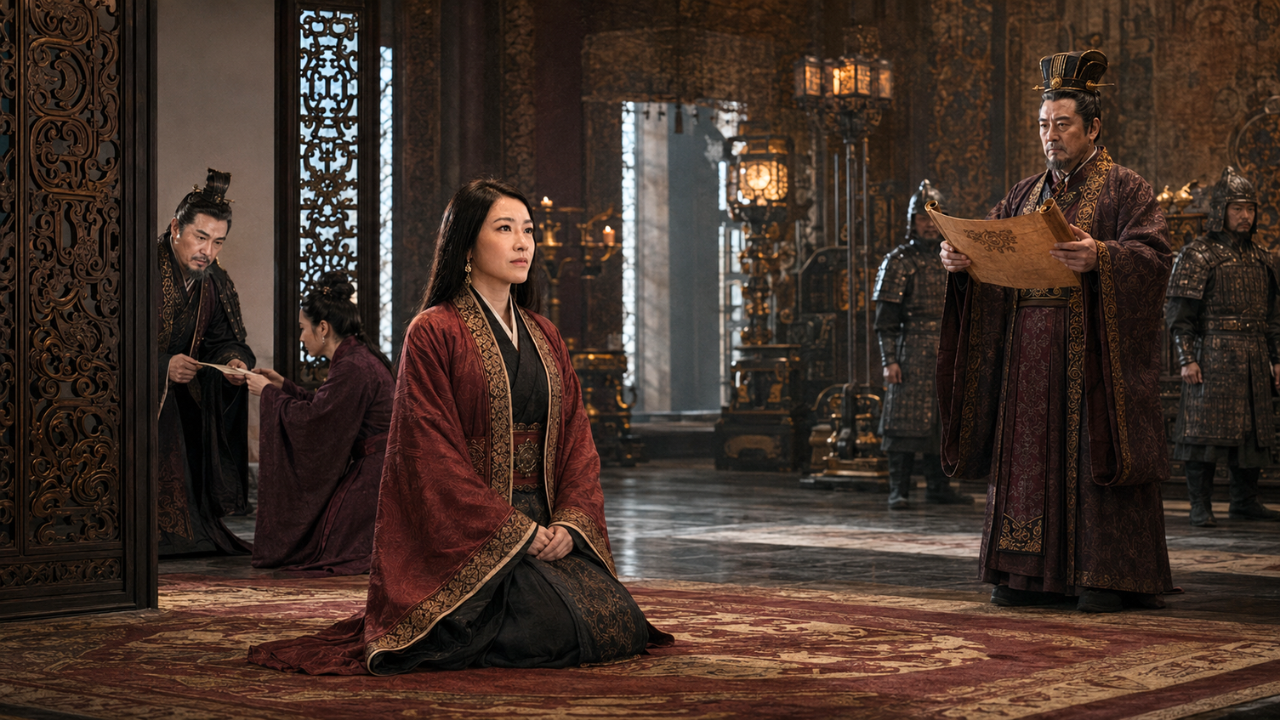
(AI Generated Visualization)
Unknown to Princess Jieyou, scouts had just reported that both Zhang Weng and the deputy envoy Ji Du were in the service of the Xiongnu.
Liu Ye quietly urged the princess to remain silent. Any attempt to defend herself would only give Zhang Weng an opportunity to twist her words before the emperor and burden her with even more accusations.
After reading Liu Ye's note, Princess Jieyou simply knelt, bowed her head in apology, and said nothing more.
Her silence only enraged Zhang Weng. Before everyone present, he seized Princess Jieyou by the hair and berated her with shocking brutality, subjecting her to public humiliation.
In truth, Zhang Weng had no authority to conduct an imperial investigation on the emperor's behalf. His duty extended no further than escorting Princess Jieyou back to the Han court and reporting the circumstances to the emperor.
Moreover, Princess Jieyou was a princess of the Han imperial house. As a government official, Zhang Weng had no right to subject a member of the imperial family to such violent and degrading treatment.
(AI Generated Visualization)
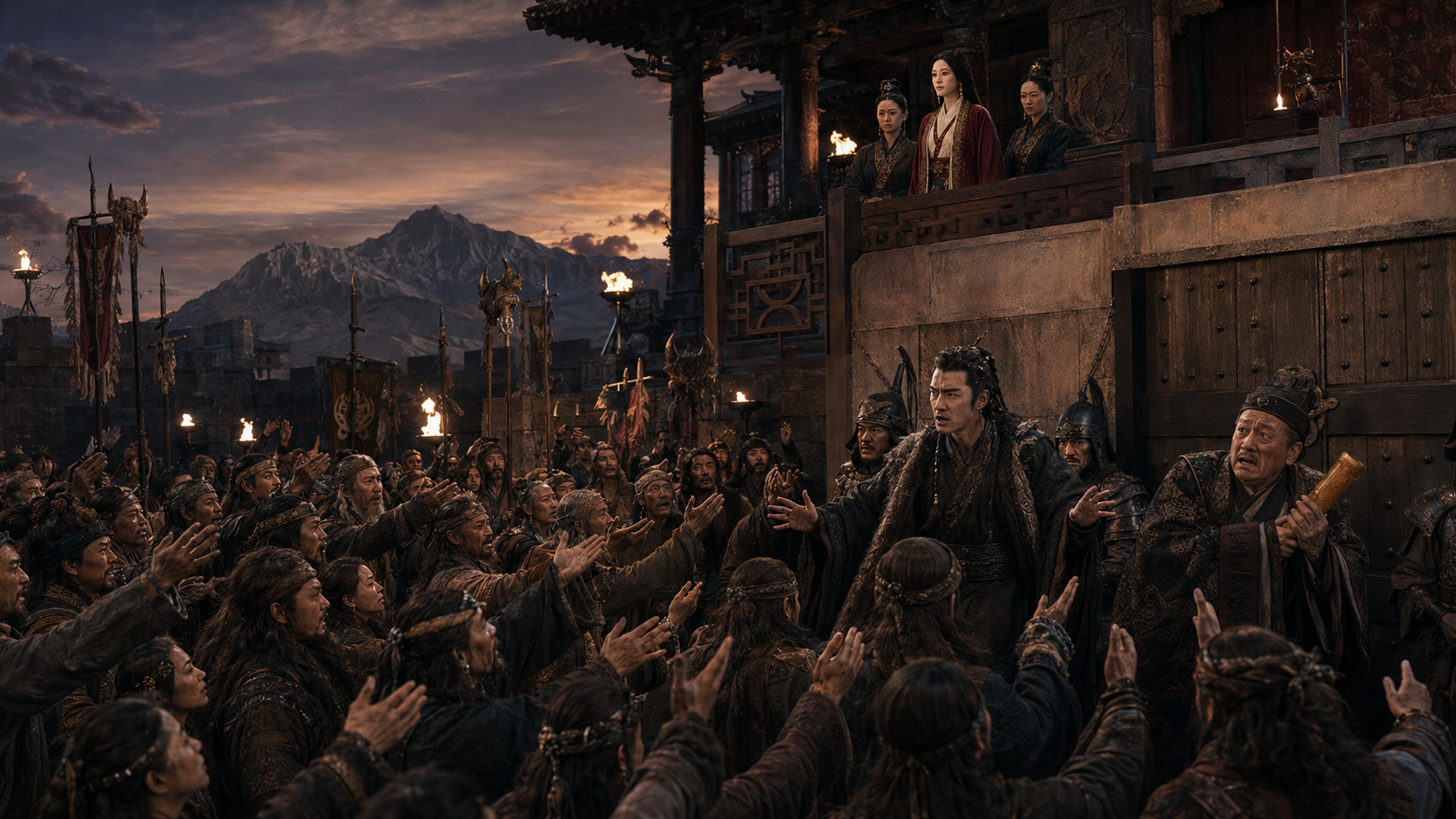
The news of Zhang Weng's public humiliation of the Mother of the Kingdom quickly spread beyond Zhi Gong Shi Ju, provoking widespread anger throughout the Kingdom of Wusun. Many believed that the emperor of the Central Plains was humiliating not only Princess Jieyou, but the people of Wusun themselves.
Ever since Princess Jieyou had come to Wusun through the marriage alliance, she and Weng Gui Mi had carried out a series of reforms for the benefit of the kingdom. Together, they eased the burdens of the people, organized disaster relief, promoted agriculture, and opened trade routes to encourage commerce. In every major decision, the welfare of the people of Wusun had always come first.
Now, however, a Han envoy had dared to publicly disgrace the very woman whom the people regarded as their Mother of the Kingdom.
Crowds of Wusun citizens gathered outside Zhi Gong Shi Ju in protest. As their voices grew louder, even Xi Shen Shou, Ni Mi's eldest son, hesitated to take further action against Princess Jieyou. The mounting public outrage also unnerved Zhang Weng, who was conducting the interrogation with brutal force.
The people demanded that Zhang Weng stop mistreating their Mother of the Kingdom. They believed the Han court had completely misunderstood Princess Jieyou's intentions. Everything she had done had been for the survival and well-being of the people of Wusun. By what authority, they asked, could a Han envoy presume to judge her?
Meanwhile, the deputy envoy Ji Du had failed to carry out the emperor's secret mission to eliminate the Mad King. Having already been bribed by the Xiongnu, he had no intention of acting against the pro-Xiongnu ruler, Ni Mi.
While Princess Jieyou remained imprisoned and under interrogation, Liu Ye immediately composed a letter and entrusted it to the civil official Chang Qun, urging him to ride day and night until it reached the hands of Emperor Xuan of Han.
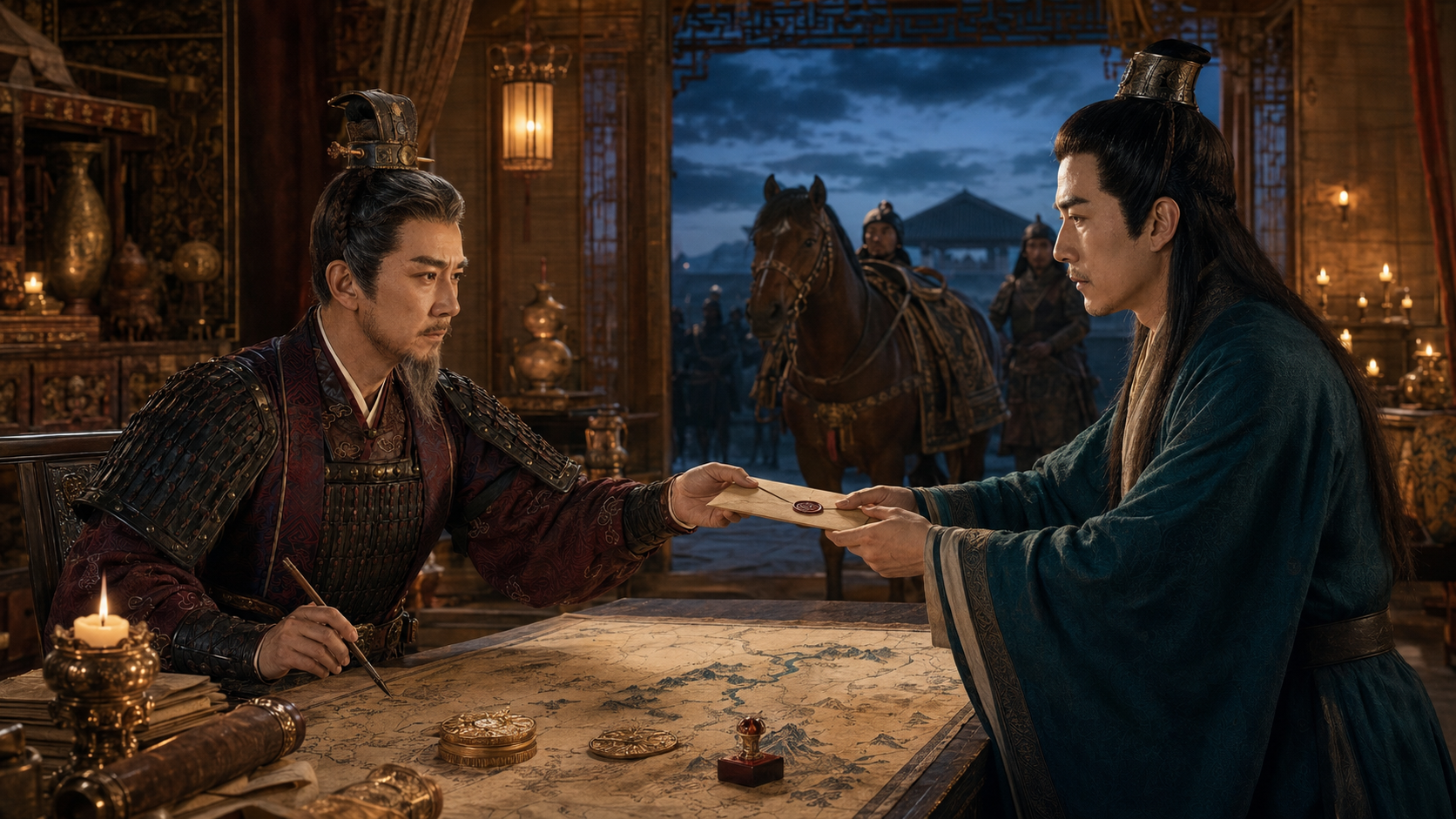
(AI Generated Visualization)
Chang Qun, a civil official who had accompanied Princess Xijun to Wusun decades earlier, had long served as the trusted courier between Princess Jieyou and the Han court. As the court historian assigned to the marriage alliances, he was also responsible for recording the deeds of both Princess Xijun and Princess Jieyou.
Only then did Emperor Xuan of Han realize that events had taken an entirely unexpected turn. He had dispatched Zhang Weng to Wusun not to interrogate Princess Jieyou.
His true intention had been to obtain from the princess a legitimate justification for the attempted assassination of Ni Mi—one that would strengthen the Han court's diplomatic position against the Xiongnu. Instead, Zhang Weng had acted contrary to the emperor's wishes, provoking widespread outrage among the people of Wusun.
Neither Zhang Weng nor Ji Du had anticipated that the protests would continue to grow. Fearing for their lives, they fled Wusun under the protection of troops dispatched by the still-wounded Ni Mi, traveling through the night to avoid being seized by the enraged crowds.
As soon as Zhang Weng returned to Chang'an, the furious emperor ordered his execution, and he was beheaded and his body abandoned in the public marketplace.
Ji Du, meanwhile, was charged with dereliction of duty, cowardice, and delaying the state's campaign to eliminate a dangerous enemy. He was sentenced to palace punishment (castration) and confined to the Can Shi, the infirmary where those who had undergone the procedure recovered.
Because Zhang Weng and Ji Du had failed in their mission—having betrayed the Han court after being bribed by the Xiongnu—the emperor could no longer openly clear the names of the Han envoys Wei Heyi and Ren Chang. Instead, he secretly provided them with generous rewards and sufficient wealth to leave the capital quietly.
Although Ni Mi survived Princess Jieyou's failed assassination attempt, his authority among the people of Wusun was irreparably damaged for three principal reasons.
First, his violent and tyrannical rule had left the kingdom filled with resentment.
Second, he had forcibly taken Princess Jieyou as his wife and compelled her to bear the prince Chi Mi.
Third, Emperor Xuan of Han had adopted a carefully balanced strategy. Publicly, he sought to preserve peace between the two states by sending physicians to treat Ni Mi's injuries and presenting him with gold and silk.
Yet after Zhang Weng and Ji Du returned to the Han court, one was executed while the other was sentenced to palace punishment.
When news of their fate reached Wusun, many concluded that the Han court had no intention of honoring or protecting Ni Mi.
Continue with Yu's Reincarnation Stories: The Saga of Princess Jieyou (Part 9)